When AI Smooths Over Chaos
Neural surrogates and fractal boundaries in the Earth–Moon three-body problem
Does ensemble-based epistemic uncertainty in a neural-network model of the planar Earth–Moon CR3BP obey power-law scaling near fractal escape boundaries, and how does its exponent compare with α = 2 − Dtrue?
The Planar Circular Restricted Three-Body Problem
Imagine standing at the barycenter—the shared center of mass on the line joining the Earth and the Moon. As the Moon orbits the Earth, rotating at the exact same rate keeps both bodies fixed on the horizontal axis. Tracking a massless spacecraft in this co-rotating plane defines the Planar Circular Restricted Three-Body Problem (PCR3BP).
In the 3D synodic model above, two trajectories initialized just
0.0015 units apart rapidly separate near the lunar gravity well—a
signature of final-state sensitivity.2
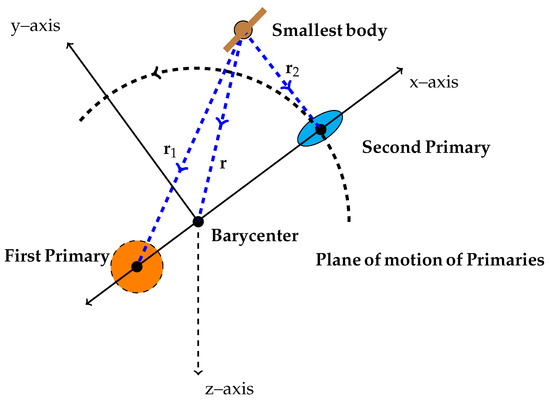
r₁ and r₂.
How Neural Surrogates Smooth Fractal Basins
Integrating millions of trajectories with high-order numerical solvers
(DOP853) is computationally expensive, motivating fast neural-network
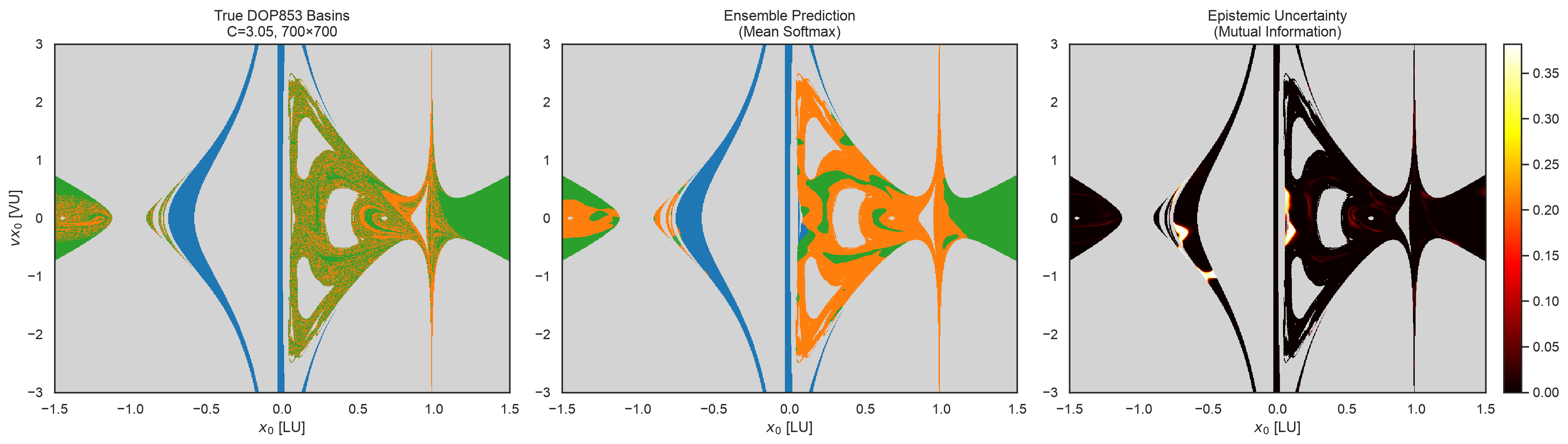
surrogates. Comparing exact physics against a 5-member Fourier-feature ensemble at
C = 3.05 exposes a striking geometric collapse:
Interactive comparison: sensor precision
C = 3.05
Tighten initial state measurement error ε (relative to
10⁻¹) to compare how slowly uncertain states shrink under true
fractal chaos (αfit) versus the surrogate's smooth
border (βflip).
At this sensor tolerance, true orbital chaos leaves 5.7× more uncertain initial states than the surrogate model predicts.
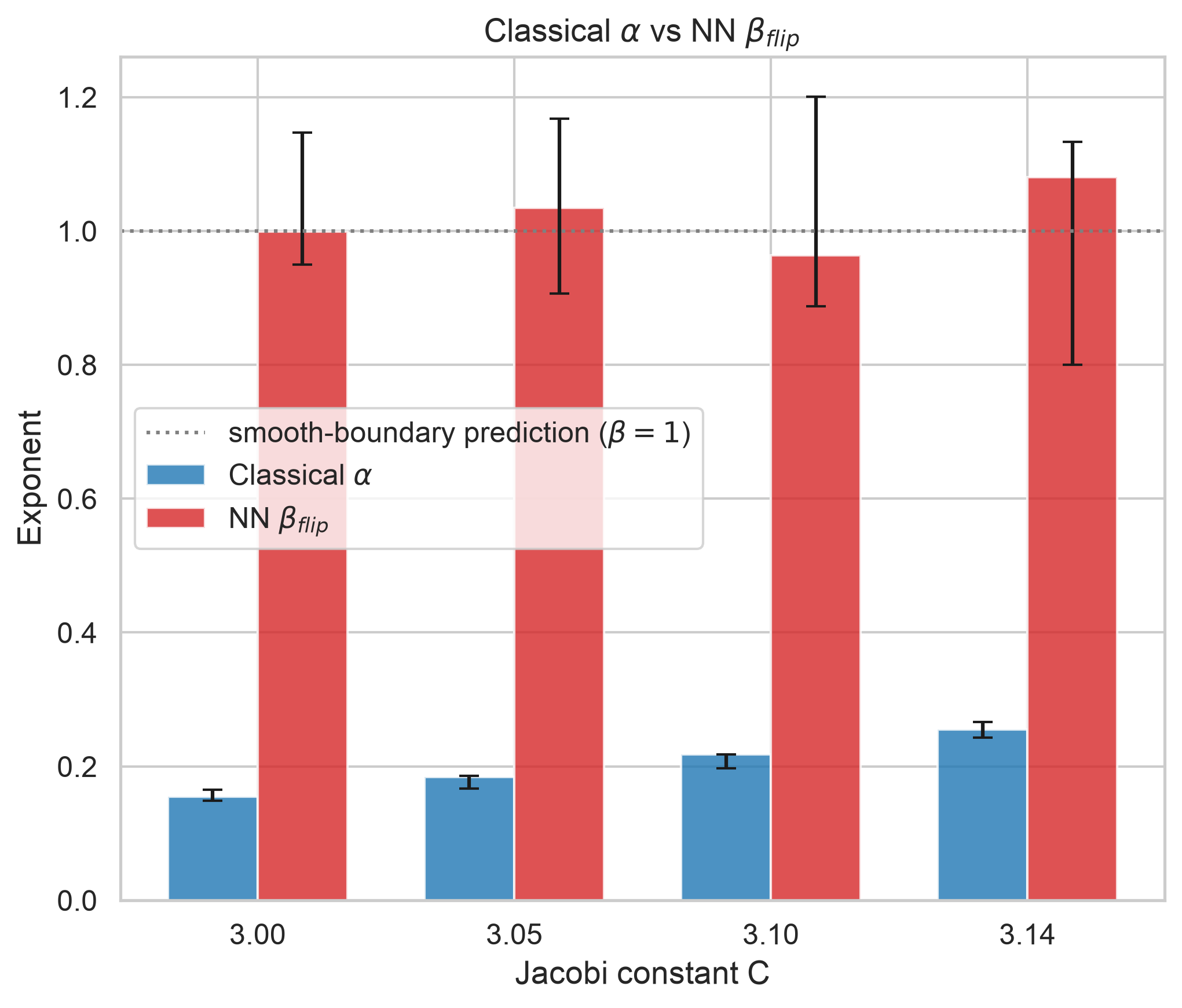
0.16–0.26, while the neural surrogate sits
near β = 1 across all four energy slices.
Measured exponents by Jacobi C
Why Model Agreement Does Not Guarantee Physical Accuracy
A standard uncertainty heuristic in scientific machine learning is
epistemic mutual information (MI), which measures how strongly
independent ensemble members disagree. At C = 3.10, MI achieved only
0.518 AUROC at locating true chaotic boundaries—barely above random
guessing—whereas predictive entropy reached 0.907.
1. True fractal boundary
Fine filaments interweave below grid scale
2. Five ensemble models (MI 0.518)
All five converge on the same smooth curve, creating false confidence
3. Predictive entropy (0.907)
Mean probabilities hover near 50/50, flagging the uncertain band
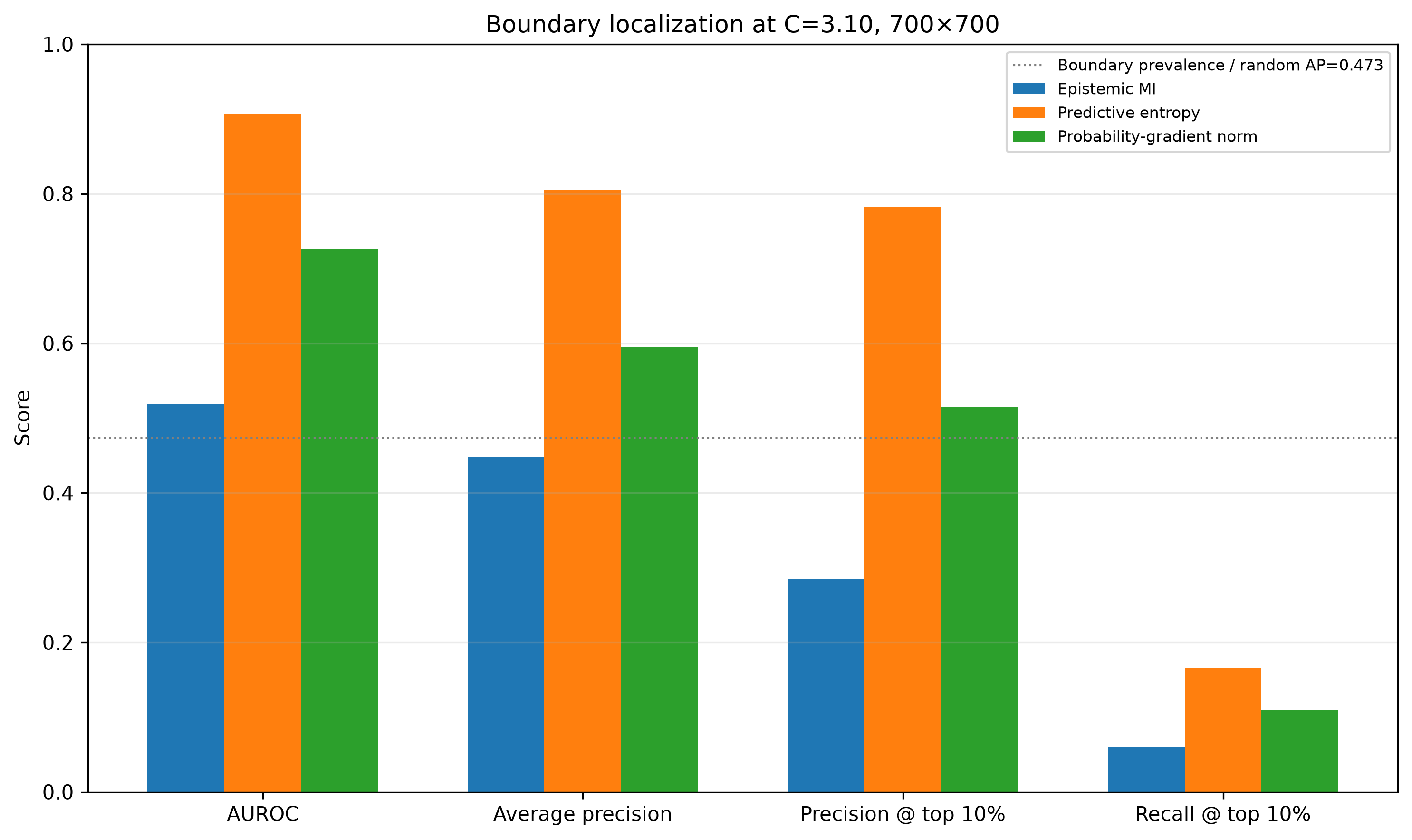
Detection AUROC at C = 3.10
Why Standard Training Smooths Over Chaos
Widening the hidden layers 4× (from 256 to 1,024 units) barely altered the learned
dimension. Yet training the exact same architecture on a deterministic
Newton fractal recovered D_learn = 1.449 against
D_true = 1.482 at 98.1% accuracy—confirming that the
network can represent fractals when sub-grid chaotic mixing is absent.
Synthetic control benchmarks
Fractal recovered
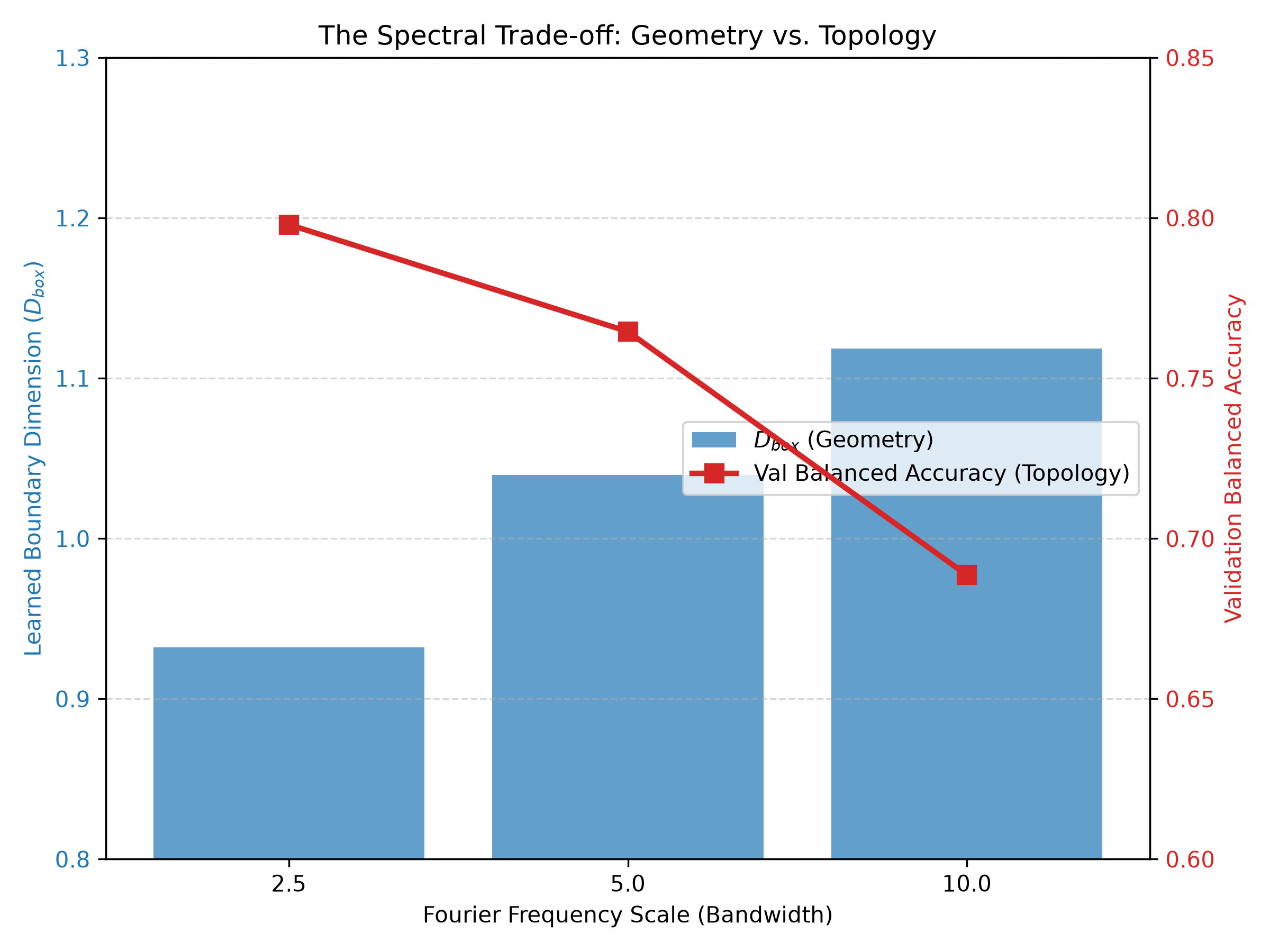
The spectral trade-off: Raising the Fourier feature bandwidth
from σ = 2.5 to 10.0 increases learned boundary
roughness (D_learn: 0.932 → 1.119), but validation accuracy drops
from 79.8% to 68.9%. Under cross-entropy, smoothing
unresolved chaotic filaments is the Bayes-optimal way to minimize average loss.
Codebase & Reproducibility
The complete simulation and training pipeline—including the parallel Rust
DOP853 integrator, PyTorch Fourier-Residual ensembles, box-counting
estimators, and bootstrap scripts—is available on GitHub.